
This article introduces some concepts about emotions. It is always good to know WHAT emotions really are, and of course there are lots of theories, from science to spiritual concepts. If you are seeking for truth here, I am sorry, the emotions are very hard to catch. So what are the basics then?
These are models to build up knowledge and understanding of what’s going on inside the emotional area. Models are helpfull tools to understand complex patterns, and they can structure this huge blob of emotional crap inside us and in others. But they are not reality. If someone confuses models and reality, it ends up in stereotypes, like: “Typical Scorpio, this behaviour!”, “Typical woman”, etc.
It works like this: learning a new model is like learning a new language. You have keywords and learn to recognize them in a situation. Then you apply patterns and structures to an unstructured life experience. Then you can see the invisible connections, the structures and rules, and mechanics of this model. Usually you have revelations and insights about whats going on, and why things are as they are. The better you learn the model and its predictions, the better you can use it on unknown situations as well.
But of course at some point model and reality won’t match. Depending on character, some people focus too much on the matches (oh look, a coincidence!) and some focus on the mismatches (the whole model is bullshit, this is the proof!).
It is also possible to extend the model – but to get it into 100% matching, you have to rebuild a complete world engine, so usually you get lost somewhere in between.
The missing thing in the model business is to let it go at some point. It was a usefull tool for understand something, and when you learned it, go to the next model. If you are adventurous, look for the most oppositional model and learn this with the same intensity as the previous one. Afterwards meditate on the “space between” this experience opens for you.
Now back to emotions: lets start with basic emotions.
Basic Emotions
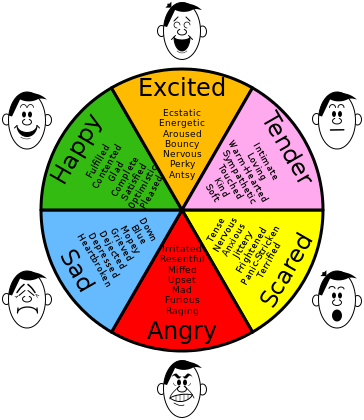
This means all your emotions go back to a handful set of basic emotions, and the complex emotions are made out of them. Basic emotions are something like: fear, anger, love, joy. The exact list depends on the author, take a look at the picture to get an idea. I can really recommend the Disney movie “Inside out” (DE: “Alles steht Kopf”): the main characters are build on these basic emotions.
You feel already uncomfortable with this model? You get +1 on logic, but -1 for understanding the introduction. You can’t deny the existance of an emotion called anger. If it exists, lets understand it, instead of rejecting the whole model.
So what is this model good for? Basic emotions ARE. They exist since our very first steps in this life, and by growing up, they get more complex. The complexity often ends in some kind of problems, so all emotional healing is about releasing the complex patterns, often a combination of emotions, thoughts/mindset, and experience. But it is impossible to remove a basic emotion.
Practice proposal: write down some emotions from yourself and try to find out what are the complex ones and what are the basic ones.
There is usually a preference for a person on one of these basic emotions. Like the background color of your life. It something like the default feeling, that one you are at home. Most people think it is happiness, but is this true? What is your default emotion, when there is nothing happening? What about your family, your closest friends – what is their default feeling if the masks are going down?
If you know a TRUE goth friend, it is very helpfull to accept that their live has another basic color, tones of black and grey. You can make a goth pretty upset by trying to make him happy and smile! If you feel at home in the darkness, I think you know what I am talking about, and why all the happy people feel so wrong.
My basic emotion is anger, I don’t know why, of course it is in my family, and yes we have a tendency to complain and getting upset about stupid things. But it is the fire inside that makes me feeling alive. For me happiness becomes boring very fast, I need more!
The fearful ones – well this is far away from my home zone, so sorry for misunderstanding – but if they turn their fears into a power, it is a great motivator to build walls, houses, money, anything that gives security. So often success in material things is related to this basic emotion.
The happiness people are those that are really happy for themselves, and see live usually in a positive way. This is also their weakness, being too positive and ignoring dangers, so they are also a source for drama. Happiness people are feeling better under positive conditions, they feel enhanced and empowered.
I am not sure if “Excited” and “Tender” are basic emotions, and there are other models with other basic emotions. If you want, you can tell me your basic emotion and how you would call it?
The main point of this whole story: there is no right or wrong. Basic emotions ARE. Removing fear or sadness is not helpfull, enforcing happiness is not helpfull. Learn to know what is yours (know thyself!), learn to accept it, learing to deal with its negative aspects and learn to develp its positive aspects.
And then start to explore unknown regions to grow. Let the goth go into happiness for just one day: https://www.youtube.com/watch?v=dwerBFJ5Ceo You will not loose anything of your home zone, it is more like increasing the home zone.
What you might loose is social acceptance. If you have a group of friends that is based on complaining about all the OTHERS, you might loose their respect having a good time with the OTHERS. And a group of PLUR (Peace Love Unity Respect) friends might have a problem with starting a successfull business, as it requires fights and aggressive power to a certain degree.
This model is applied in a lot of alternative healing methods: sanguinic/choleric/melancholic/phlegmatic in greco-roman humorism, elements: fire/water/earth/air, Meridians and elements in TCM, blood groups, and so on. Any kind of typology is using this model! This can still be helpfull, if the limited capabilities of this model are known. But if not, it ends up in pseudo-spiritual mindfuck.
Limitations of this model: it is static, so it is not flexible enough to deal with everyday emotional changes. And there is nobody at 100% of one basic emotions, all you can get here is a tendency to one. Or two.
Dimensional Qualification of emotions
Dimensional Qualification means: we have two extremes (0% and 100%), and then you are at a certain amount in between. The emotional dimensions are for example:
- comfortable – uncomfortable
- active – passive
- desire – aversion
- …
This model is adding more flexibility to emotional descriptions. Any dimension can be measured between 0 and 100%, and it can change by time and situation. Dimensions are a good way of taking a step back from specific emotions with all their stories and difficulties. With them you can get access to the tendencies, motivations, overall streams without getting lost in details. You can apply them to a person or a situation.
For example:
The overall tendency to positive, pleasurable, fulfulling emotions now can easily be seen as a behaviour of moving the comfortable – uncomfortable marker into the comfortable region. We are not bound to one special emotion (love, happiness, excitement), as long as it is “feels good”. Even some kind of fear (increases excitement) or sadness (melancholic beauty) can be added to the mix. I think the live concept with the the misleading “happiness” idea – is moving the comfortable dimension into ~70%. Some kind of uncomfortable things are OK, as everybody needs challenges and problems to solve, as long as it stays above 50%.